
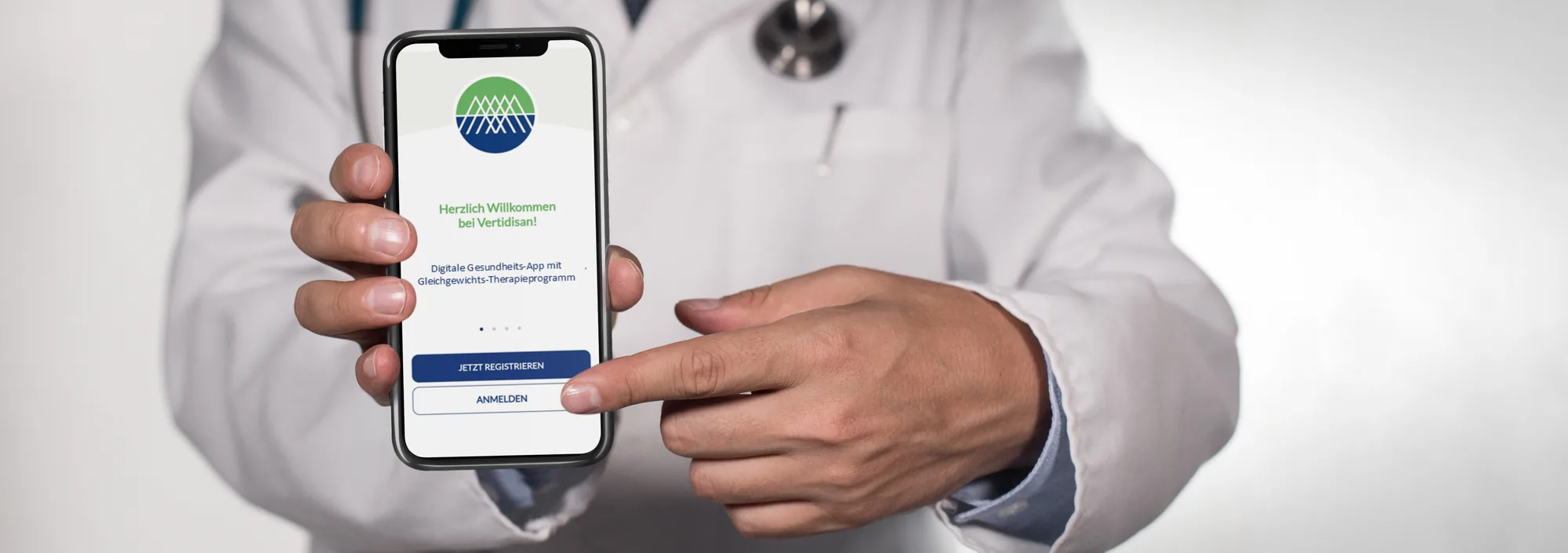
Information for Physicians
Vertidisan® app (VH90D; VH-90-D) – digital vestibular retraining app for 90 daily therapy sessions at home.
1. Name, product description & intended purpose
Name: Vertidisan® (VH90D; VH-90-D)
Product size: >300 therapy units, 90 therapy sessions per prescription
Product description: Digital health application with an interactive, multimodal, diagnosis-adapted VH90D vestibular exercise program (90 sessions).
Intended purpose: Vertidisan serves to improve vertigo in peripheral balance disorders, as well as the documentation of manually entered health data and its transmission. Vertidisan is not intended to produce or supply information for diagnostic or therapeutic decisions.
2. Composition / content
VH90D: (1) sensorimotor/optokinetic exercise program (ABEV), (2) CBT, (3) Medical Counseling (MC), (4) Progressive Muscle Relaxation (PMR), (5) Autogenic Training (AT), (6) Health Education (HE), (7) Otago Exercise Program (OEP). Details: Composition/content of Vertidisan
3. Administration
Form: Digital health app for Android/Apple smartphone/tablet.
Prescribed quantity: once daily; 90 therapy sessions per program; repeatable if medically indicated.
4. Clinical information
4.1 Mechanism of action: Central vestibular compensation through neural learning based on the plasticity of the central balance function system. Prescribable medical device, also available without a prescription.
4.2 Patient group: Peripheral vestibulopathies · 4.3 Age group: Adults aged 18 and over
4.4 Indications: Benign paroxysmal positional nystagmus (BPPN), trauma (e.g. labyrinthine concussion/contusion, skull base injuries), labyrinthitis (toxic, bacterial, viral), functional vertigo/PPPD/phobic vertigo/chronic vestibular syndrome, tumors of the skull base and cerebellopontine angle (acoustic neuroma), presbyvertigo (age-related vertigo), Menière's disease/Lermoyez syndrome, vestibular migraine, semicircular canal dehiscence, acute vestibular syndrome, vestibular neuritis, vestibular paroxysmia, bilateral/unilateral vestibulopathy, sudden hearing loss with vertigo, toxic vestibulopathy, idiopathic vertigo.
| ICD-10 | Designation |
|---|---|
| H81.0 | Menière's disease |
| H81.1 | Benign positional vertigo |
| H81.2 | Vestibular neuronitis |
| H81.3 | Other peripheral vertigo (incl. vertigo: ear, otogenic, peripheral NOS) |
| H81.8 | Other disorders of vestibular function |
| H81.9 | Disorder of vestibular function, unspecified (incl. vertigo syndrome NOS) |
| R29.6 | Tendency to fall, not elsewhere classified (incl. tendency to fall in the elderly) |
4.5 Contraindications: Cervical spine disorders, acute inflammatory diseases, feverish conditions, cardiovascular decompensation, pulmonary insufficiency, motor disorders, seizure disorders (e.g. epilepsy), spinal cord injury, psychoses, skin sensitivity disorders with impaired gait, pregnancy, thrombosis, coagulation disorders/anticoagulant therapy, large skin defects, severe burns, malignant metastases, severe visual impairment, frailty syndrome.
4.6 Side effects: see Side Effects
4.7 Reporting of risks/side effects: BfArM (German Federal Institute for Drugs and Medical Devices, www.bfarm.de); to the manufacturer by e-mail to meldung@vertidisan.com (not sufficiently confidential) or by mail, also anonymously: Digitineers GmbH&Co.KG, –Physician matter–, Austria: Mariahilfer Str. 123/3, 1060 Vienna (info@vertidisan.com), Germany: August-Bebel-Str. 9, 72072 Tübingen (Headquarters).
4.8 Interactions: No known biochemical/pharmacological interactions; do not use together with medications that increase the risk of falls.
4.9 Pregnancy: Do not use (no data available). · 4.10 Driving/operating machinery: No restriction, as long as no vertigo is triggered.
5. Product characteristics & technical requirements
Online-based, CE-marked medical device. Training is possible without medical supervision, although prior medical confirmation of suitability is recommended. Does not replace medical diagnosis or treatment. The access key entitles the holder to 90 therapy sessions after initial registration.
Technical requirements: Smartphone/tablet with internet access and an e-mail address; no special computer skills required.
6.–8. Manufacturer, UDI & declaration of conformity
Manufacturer: Digitineers GmbH&Co.KG, Austria: Mariahilfer Str. 123/3, 1060 Vienna (info@vertidisan.com), Germany: August-Bebel-Str. 9, 72072 Tübingen (Headquarters)
Basic UDI-DI: 42700027834VH90-DN6
CE declaration of conformity: dated 19/09/2022 – Download PDF (881 KB)
Prescribing & reimbursement
Prescribing works the same way as for a medication: diagnosis and prescription by means of a prescription stating "Vertidisan". Private patients receive the activation code online via vertidisan.de. Statutorily insured patients can apply for cost coverage through their health insurance fund (see Download & Activate). The prescription is outside the regular drug budget; there is no budget cap.
Data protection & cybersecurity
Very extensive data protection measures. Interoperability with practice management software and the electronic patient record (ePA) via the KBV toolkit. Passed penetration tests according to the BSI standard. Covers integrity, confidentiality/privacy, safety, security and interoperability (KBV toolkit per § 355 SGB V). Details: Product Technology
Findings report for physicians
Digital or analog findings report available at the patient's request. Digitally as a PDF or transferable via the KBV's MIO-DiGA toolkit into the practice system or the ePA. Download instructions (PDF, 155 KB)