

How Does Vertidisan Work?
A holistic, individually adapted therapy approach – developed by research university medical professors, based on medical evidence.
Holistic, adapted therapy approach
Vertidisan engages both body and mind in the therapy – based on the modern scientific foundations of conventional medicine. The mechanism of action is neural learning based on the plasticity of the central balance function system, as well as on a cognitive level.
Tailored to your vertigo
The therapy is tailored to your individual vertigo condition – the program is continuously adapted according to your own input in the app.
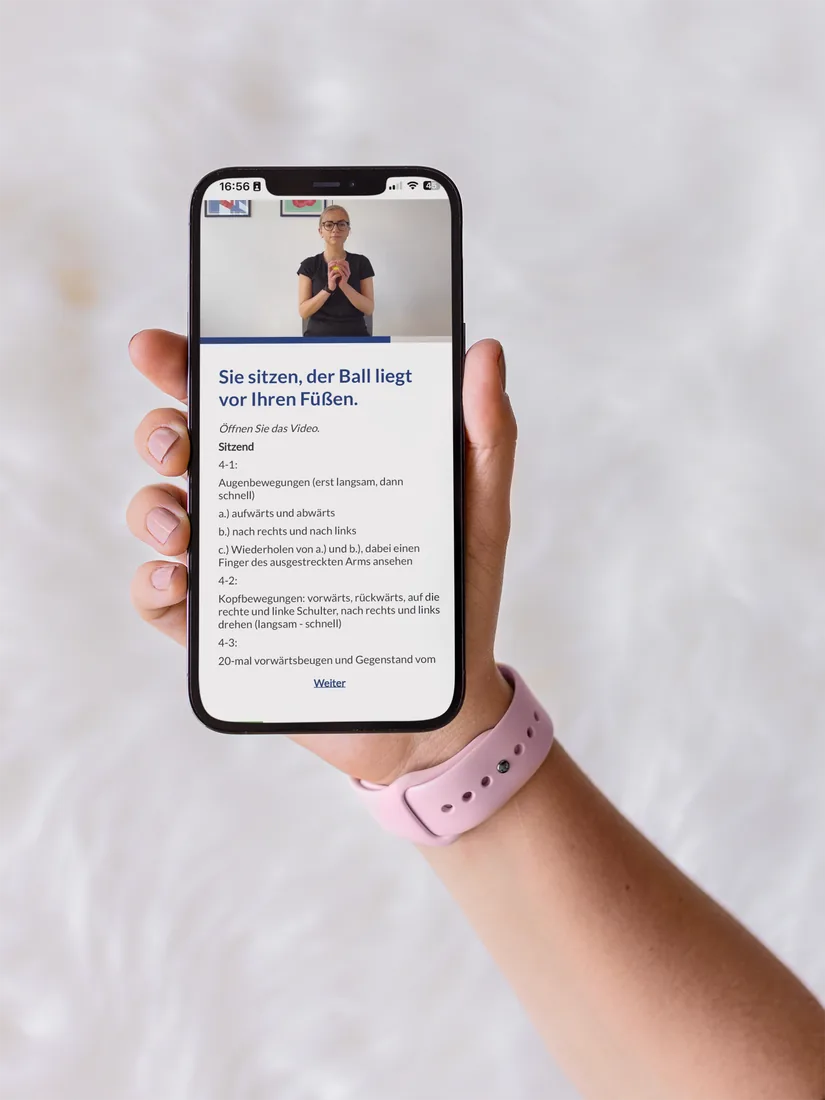
How each individual component works
ABEV therapy units (sensorimotor & optokinetic)
Individually tailored sensorimotor ABEV balance exercises (Adaptive Balance Exercises including visual stimulation) often achieve the goal of overcoming vertigo. They are divided into vestibulo-motor (inner ear → brain → leg muscles) and vestibulo-ocular (inner ear → brain → eyes) exercises.
When signals from one or both inner ears change due to illness, the balance system in the brain becomes "confused" – the signals appear contradictory, and you experience vertigo. The brain can learn to process these signals better: repeated ABEV exercises trigger a neural learning process that reduces or eliminates vertigo – central vestibular compensation.
OEP: Otago Exercise Program
For patients prone to falls, the "Otago Exercise Program" strengthens the musculature, especially of the legs, in addition to the ABEV exercises – further reducing the tendency to fall.
Repositioning maneuvers
Some forms of vertigo can be treated remarkably well with targeted repositioning maneuvers. Depending on your input, these are optionally included in the therapy concept and lead to direct mechanical changes in the ear and/or support the learning process as with the ABEV exercises.
Medical counseling & health education
Without understanding what is happening in your own body, therapy is often unsuccessful. Vertidisan offers an extensive, layperson-friendly specialist knowledge base with quiz questions.
Cognitive behavioral therapy (CBT)
Vertigo is often associated with stress or anxiety disorders. Vertidisan includes dedicated cognitive behavioral therapy sessions for this purpose.
Autogenic training
Sensors in the arms and legs play an important role for balance. Autogenic training trains conscious perception of arm and leg movements without visual control – relying solely on the balance system.
Progressive muscle relaxation (PMR)
Vertigo often leads to increased muscle tension, which irritates the sensors in muscles and tendons. PMR specifically reduces this state of irritation.